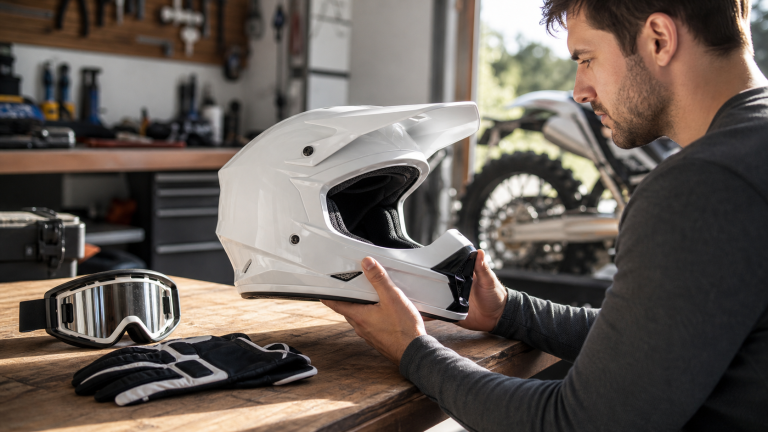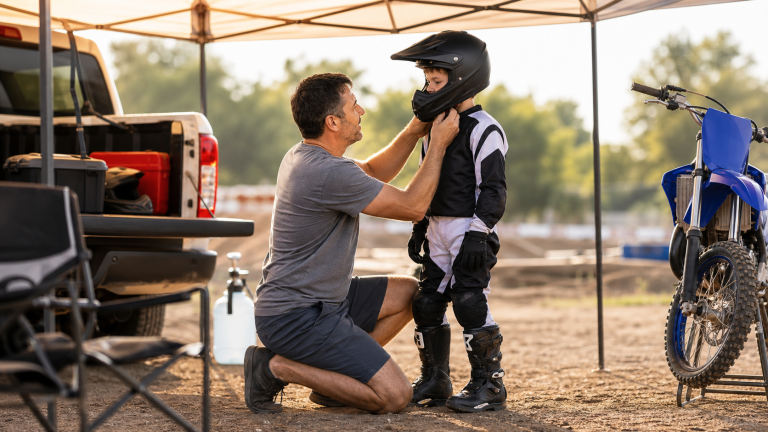

When to replace a motocross helmet is really two questions that get merged into one bad answer. One has a hard, unanimous answer: after an impact, the helmet is finished. The other — the famous five-year rule — turns out to be far softer than the way it is usually repeated, and the organisations that originated it say so themselves.
After an impact, replace it #
There is no disagreement here across any source worth reading.
The Snell Memorial Foundation put it bluntly: their certified helmets are all crash helmets that work well managing severe impact shock in only one accident. Their instruction follows from that — if the helmet has been involved in an impact while in use, replace it.
6D say the same from the manufacturer’s side, and add the part that catches people out: any helmet suffering a significant impact to the shell should be removed from use immediately, whether there is visible physical damage or not. A helmet is built to deform in order to absorb the energy of the crash, which is a one-way transaction.
The Bicycle Helmet Safety Institute, writing about bicycle helmets but describing the same material, explain why a clean-looking shell proves nothing: the foam part is made for one-time use, and after crushing once it is no longer as protective as it was. That crushing can sit hidden behind the comfort padding.
So the rule is simple. If it was on your head and it hit something, it is done, however good it looks.
Dropping it off the handlebars is not a crash #
The opposite mistake is just as common, and it costs riders money for nothing. Snell are explicit: if your helmet drops to the ground from your hand, off a seat or the handlebar of a motorcycle, you do not have to replace it.
Their one caveat is about repetition rather than a single event — frequent dropping, or spiking a helmet onto hard surfaces, may eventually degrade its performance. A knock off the bars in the paddock is not an impact in the sense the standard means.
Where the five-year rule actually comes from #
This is the part the industry tends to skip. Snell describe the five-year interval honestly as a judgement call, based on testing helmets used by the California Highway Patrol. The mechanism they point to is wear rather than decay: the simple act of putting helmets on and taking them off damages the comfort pads and the energy-absorbing foam liner over time.
They also state something you will rarely hear in a shop — unused helmets stored in good condition do not automatically expire after five years.
BHSI go further. On bicycle helmets they say plainly that most manufacturers now recommend replacement after five years, but some of that may be just marketing. They cite the Snell Foundation’s own testing of motorcycle helmets held in storage for more than 20 years, which still met the original standard, and a 2015 MEA Forensic study of used-but-not-crashed bicycle helmets — some as old as 26 years — which found no significant impact performance change with age.
Treat the bicycle-specific findings as what they are. But the direction of the evidence is consistent: helmet foam sitting in reasonable conditions does not quietly rot on a five-year timer.
A motocross helmet is not a stored helmet #
Here is the reconciliation, and it is the genuinely useful conclusion. Age on a shelf is not what kills your lid. Use is.
6D state the expected lifespan of their helmets as five years of seasonal use, decreasing as the frequency of use increases — and they are direct that helmets used for competition such as motocross tend to have a much shorter life span. Their stated reason is exposure: the more a helmet endures the elements, body oils and perspiration, the faster it wears out.
Put those together and the calendar is the wrong instrument. A helmet worn twice a month for five easy summers is a different object from one raced every weekend for two seasons, soaked in sweat and baked in the sun. The second is the one to be suspicious of, even though it is younger.
The two things the sources identify as wearing out are worth inspecting directly: the comfort padding and the energy-absorbing liner Snell describe, and the sweat and oil exposure 6D describe. Washing the removable padding properly rather than letting it marinate is part of extending that — the same routine as the rest of your kit, covered in our guide to cleaning and maintaining motocross gear.
What the manufacturers will do after a crash #
Worth knowing before you bin a crashed helmet, because some makers run crash-replacement schemes. These are the manufacturers’ own programmes, not something a retailer provides, and their terms are theirs to change — check the current conditions before counting on them.
Leatt’s stated terms at the time of writing: the damage must be crash-related rather than from improper handling or misuse, the helmet must have been purchased no longer than three years before the date of submission, and you supply a copy of the purchase receipt, images of the damaged helmet and detailed information about the crash. What you get is a 40 percent discount off original retail on a replacement, not a free helmet. They describe it as global support handled through a partner in your country, with a 48-hour average response time.
Separately, note that a warranty is not a crash-replacement scheme. 6D’s warranty is a three-year limited warranty from the original purchase date on most models, with some variants differing — the ATB-1T carries one year. Warranties cover defects, not the consequences of using the helmet as intended.
The practical version #
- Impact while worn: replace it. No inspection, no judgement call, regardless of how it looks.
- Dropped from your hand or the bars: keep riding it. Unless you make a habit of it.
- Judge age by use, not by the date on the box. Hard seasons of racing count for far more than calendar years.
- Inspect what actually degrades — the comfort padding and the liner underneath it — rather than trusting a birthday.
- Check the crash-replacement terms of your helmet brand before you throw a crashed one away.
If you are replacing one, the standard it is built to is the other half of the decision. Our ECE 22.06 guide explains what the current homologation actually tests, and our guide to choosing a motocross helmet covers fit and shell sizing. You can see what is available in the helmets range.
Sources #